Brands have always been a part of business, but their role has changed dramatically over time. Originally, a brand was little more than an identifier: a way to show who produced an item and whether it met certain quality standards. It was practical, neutral, and transactional.
Then social media changed everything.
Suddenly, brands could speak. They became voices, characters, values, and even ideologies. Customers started following brands not just for their products but for what those brands stood for. But the digital world didn’t stop there.
Today’s buyers are overloaded with options. Every click, scroll, and swipe exposes them to countless alternatives. Competition is no longer limited to similar products; it now includes anything that can grab a person’s attention for a few seconds. As a result, the “bigger is better” branding approach began to lose ground.
Modern brands grow not by expanding broader, but by going deeper. They resonate with smaller, more specific audiences. That’s how micro-brands emerged, and they’ve already started transforming both the market and consumer behavior.
In this article, we’ll take a closer look at micro-brands. We’ll explore how the consumer journey evolved from a simple linear funnel toward what behavioral scientists now call “ the messy middle.” We’ll define what a micro-brand really is, explain why it works, how you may have built one already without noticing, and show exactly how to create one for your Offiro store to stand out in today’s competitive landscape.
Let’s dive in.
Part 1. Revolutionizing the Customer Journey

From AIDA to a new reality
For decades, the AIDA model was the foundation of marketing and sales. It outlined a clear, predictable journey:
Marketers built campaigns around this logic, expecting customers to progress through these stages step by step.
But in 2020, Google introduced a concept that disrupted this understanding entirely – “ the messy middle.” Based on extensive behavioral research, it revealed that today’s customers don’t follow a straight path. Instead, they enter a complex, often chaotic decision-making zone long before taking action.
What exactly is “ the messy middle”?
Imagine a customer already aware of their need, whether it’s choosing a new gadget, signing up for an online course, or deciding which bank to trust with their savings. Their journey doesn’t smoothly progress toward a purchase. Instead, they are pulled into a turbulent stage where two forces interact in a continuous loop:
| Stage | Description |
| Exploration | The customer actively searches for new brands, options, features, and reviews. They expand their horizons. |
| Evaluation | They compare, analyze, eliminate, and narrow choices. They deepen understanding and seek confirmation. |
This loop can repeat multiple times, influenced by whatever the customer sees next – a review, a social media post, a trend, a friend’s opinion, a Google ad, or even a casual conversation.
It’s a mental rollercoaster:
“Looks great!” → “Hmm, maybe not.” → “This could work.” → “No, too expensive.” → “Actually, it’s kind of cool…” → “Ugh, maybe next time.”
Why did the journey become so messy?
There’s nothing mysterious about this change: it’s the result of the digital era reshaping consumer behavior:
- Choice paralysis. No matter what you sell – toothpaste or a high-ticket MBA program – the number of options is overwhelming
- Information overload. Even digital-native generations struggle to filter through ads, expert opinions, influencer content, and unsolicited advice
- Falling trust in traditional messaging. Consumers have grown resistant to generic slogans and polished commercial language. They want authenticity
- The rise of social proof. A well-written negative review can outweigh dozens of ads. Conversely, a single compelling testimonial can close a sale
- Instant access to data. People compare options on their phones during lunch breaks, while waiting for coffee or sitting in traffic
The funnel still exists, but it’s no longer where the battle is
AIDA hasn’t disappeared completely. It still outlines the broader journey. But the real competition now happens inside the messy middle, where brands are fighting for three things:
This is precisely where micro-brands excel.
Unlike traditional campaigns, micro-brands aim to create meaningful experiences around specific products or niche audiences. They focus on genuine relevance, emotional connection, and identity.
And in a world where the customer journey is anything but linear, that depth is what makes the difference.
Part 2. Micro-Brands: Your Mass Engagement Tool

A brand within a brand
Now that we’ve explored how consumer behavior has changed, let’s focus on the concept at the center of today’s competitive advantage: the micro-brand.
A micro-brand is a focused extension of your main brand, created around a specific product, product line, or tightly defined audience. Think of it as a brand within a brand or a specialised division that delivers a deeper, more personal experience.
A strong micro-brand typically has:
- Its own vibe – a distinct emotional atmosphere surrounding the offer
- Its own tone of voice – carefully shaped to match the target audience’s mindset, expectations, and values
- Its own visual identity – unique and recognizable, while still aligned with the core brand
If your main business already targets a niche audience, you may already be a micro-brand.
“You’ve probably created micro-brands already”
Even if you’ve never used this term before, chances are you’ve done it in practice.
If you’ve ever created any of the following, you’ve already worked with micro-brand principles:
- online courses with dedicated style and naming
- private groups or communities with rules and exclusive perks
- challenge formats with a unique tone and identity
- lead magnets that use their own voice and design
- podcast, video format, or themed content series
- workshops, webinars, or masterminds
- live meetups or conference concepts
If you answered “yes” to any of these — congratulations, you’ve already engaged in micro-branding.
You had clarity about the audience, their needs, and how to present your idea in the most appealing form.
Micro-brands in action: pulling customers out of the messy middle
Earlier, we discussed how customers get stuck in the exploration–evaluation loop of the messy middle. Your goal is to give them something strong enough to interrupt it.
Successful micro-brands do exactly that by:
| What a micro-brand does | Why it matters |
| Attracts attention | Unique identity cuts through the noise immediately. |
| Communicates value instantly | Customers recognize “this is exactly what I need.” |
| Boosts perceived value | Suggests higher intent, care, and investment behind the offer. |
| Builds emotional connection | Goes beyond practicality and adds aspiration, meaning, personality. |
In simple terms:
Part 3. Enthusiasm Doesn’t Sell — Micro-Brands Do

Why passion alone is not enough
Let’s be honest: the market is oversaturated. Small businesses offer dozens of products or services. Larger companies offer thousands. Standing out in this environment feels like trying to shout across a crowded stadium.
You may know how powerful your product is. You may see how your idea can genuinely improve someone’s life. You may be inspired, motivated, even emotionally attached to what you’ve created.
But here’s the hard truth:
Your target audience — those you proudly refer to as your ideal clients:
- can’t feel your passion, no matter how strong it is
- are numb to bold claims and polished ad copy
- are drowning in similar offers from equally passionate entrepreneurs
- don’t care about your emotions. Instead, they respond to relevance, clarity, and proof
Enthusiasm drives you forward. But on its own, it doesn’t drive conversions.
So what does?
And this is exactly what micro-brands are built around.
Instead of trying to show your excitement, micro-brands help your audience feel something for themselves. They allow customers to experience your offer as something designed precisely for their needs. They transform your passion into an inspiration others can relate to.
A practical example: Exelse.com
One of the most successful stores in the Offiro portfolio is Exelse.com. At first glance, selling digital products related to style and personal image might seem like a competitive and fast-moving niche, especially if someone doesn’t actively follow fashion trends.
And yet, the store consistently performs well.
Why?
Because it taps into an emotion that resonates universally:
Self-expression with confidence.
Exelse offers customers a way to feel more assured in how they present themselves. The micro-brand behind it revolves around personal identity, refinement, and the ambition to stay ahead without sacrificing individuality.
Once people perceive this message, the buying logic changes:
“Digital resources about style”
↓
“Tools that help me express who I am more confidently”
↓
“I want that feeling — it fits me.”
That’s the power of a micro-brand. It transforms a product from something useful into something meaningful. And when that happens, people purchase – and then they return and recommend.
In the next section, we’ll explore how to create a micro-brand yourself step by step, and how to apply it to your Offiro store.
Ready to build one?
Part 4. How to Create a Micro-Brand

The key to building a successful micro-brand lies in maintaining a delicate balance between uniqueness and consistency. On one hand, your micro-brand must clearly stand out: it should highlight a distinct offer and speak directly to a specific audience. On the other hand, it must align with your core brand values and tone of voice to remain credible and authentic.
Here’s how to build one step by step.
1. Start with your strongest offer
Identify a product or solution that can become the centerpiece of your micro-brand. Typically, it is:
- your flagship item
- a promising new direction
- a high-value niche product
This is your foundation. A micro-brand works best when rooted in something you genuinely believe in and see potential for.
2. Deep-dive into audience insights
To build a micro-brand that resonates, surface-level demographics won’t be enough. Ask yourself:
- What problem does this offer solve better than any alternative?
- What values, aesthetic preferences, and lifestyle choices characterize your audience?
- What do they worry about?
- What do they aspire to?
Your goal is to make your micro-brand connect with customers on a personal level.
3. Discover your core concept
The concept is the emotional or symbolic anchor of your micro-brand. It can be built around a metaphor, a mission, a cultural reference, or even a community.
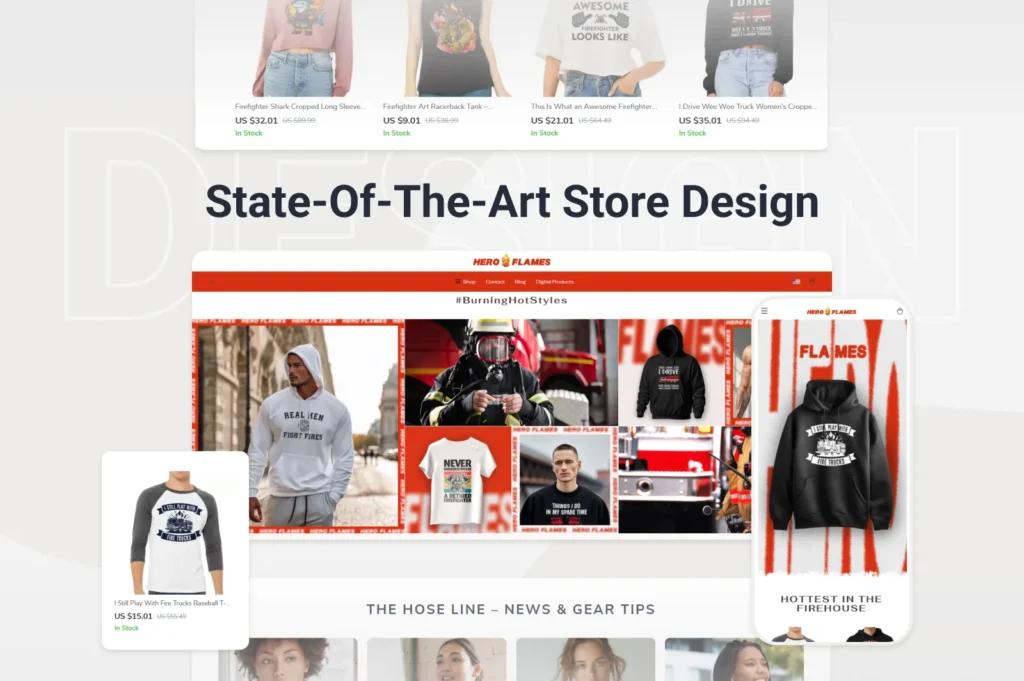
HeroFlames.com, for example, is shaped by the idea of honoring real-life heroes, not by selling thematic apparel.
Think of it as the narrative engine that drives style, visuals, and messaging.
4. Craft a visual identity
Visuals must reflect the core concept powerfully and instantly. For HeroFlames.com, this includes bold colors, strong typography, dynamic imagery, subtle references to fire, and resilient character representation.
Ask yourself:
- What colors communicate the emotion of your micro-brand?
- What imagery resonates most with your audience?
- Do your visuals suggest the right values (strength, care, creativity, etc.)?
5. Develop a tone of voice
Your micro-brand should “speak” consistently and purposefully:
| Tone characteristic | Questions to explore |
| Formal or casual? | How do customers prefer to be approached? |
| Inspirational or tactical? | Do they seek motivation or structure? |
| General or niche language? | Should you incorporate subculture terms or slang? |
Your tone must reflect your audience’s worldview, not just your own enthusiasm.
6. Bring it to life on your website or landing page
With Offiro, you’re not limited to a single design path. You can:
- refine layouts
- add or remove visual blocks
- reorganize categories
- experiment with copy and structure
Your micro-brand can emerge as a dedicated product page, collection, or thematic landing.
7. Infuse the micro-brand into every touchpoint
To reinforce the experience, extend your micro-brand across all customer interactions:
- Email sequences
- Social media content
- Chat/messenger tone
- Packaging ( where applicable)
- Post-purchase communication
Consistency generates recognition. And recognition creates trust.
It may seem like a lot — and it is. But not all of it is hard work.
Creating a micro-brand involves creativity, testing, and refinement. You try, measure what works, and remove what doesn’t. The biggest challenge is starting, but with Offiro, you don’t start from scratch.
You can easily adapt and extend it into a micro-brand that reflects your vision while generating orders and revenue from day one.
Final Thoughts

Today’s consumer journey is no longer linear. Instead of smoothly moving through awareness, interest, desire, and action, buyers now cycle through research, comparison, doubt, and discovery — the messy middle. In this environment, broad branding attempts struggle to stand out. That’s why micro-brands have become so powerful: they don’t aim to speak to everyone, only to those who are most likely to care. And in a saturated market, relevance beats reach.
Micro-brands transform enthusiasm into clarity and connection. They make customers feel seen, understood, and personally addressed. Rather than trying to convince people with generic claims, micro-brands pull them out of indecision by offering meaning, personality, and emotional relevance around a specific product or niche. It results in faster decisions, higher loyalty, and a brand that sticks.
What’s important is that you don’t need to be a big company or have extensive resources to create one. Offiro stores often launch as niche projects with demand already validated. You start with a working business and then deepen it into a micro-brand that reflects your values and vision. With a ready-made audience, professional branding foundation, and expert support, you can evolve your store into something both commercially strong and personally meaningful.
In a world overloaded with options, the businesses that win are the ones that feel authentic and intentional. With Offiro, you enter the market with identity. And when your brand speaks directly to someone, the messy middle stops being an obstacle and becomes a turning point.
Ready to take the first step? Contact our experts today to find the perfect store for you and start 2025 with a business that’s ready to grow.